Infopeople Webinar
Tuesday, February 14, 2012
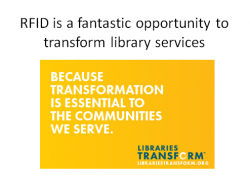
Infopeople webinar highlighting the trends in materials handling including:
- Pricing of AMH systems going down
- Quality of AMH systems going up
- Automated check-in with sorting becoming standard
- Kiosks a hit but still a tad buggy
Lots of info about automated check-in systems, small sorters, advancements in sefl-check-in technology, kiosks and dispensers and new AMH products entering the market.
Edgy Librarian 2012
Wednesday, February 1, 2012
Presented Open Source and RFID Update at the Edgy Librarian online conference. This PDF file includes the slides as well as speaker notes.
Available here.
White Paper
Saturday, December 31, 2011
This white paper identifies the key benefits of sharing a library system in the context of today’s technological environment. The benefits include cost savings, improved resource-sharing opportunities, providing a higher quality system staff, improving the quality of the collection, streamlining library workflows, optimizing the patron experience, eliminating routing slips and pre-sorting, and adding value to the consortial affiliation.
White Paper: Why A Shared Library System Makes Sense
CLA Annual Conference
Sunday, November 13, 2011
This was a joint presentation with Henry Bankhead of Los Gatos Public Library, Kevin Pischke of William Jessup University, Scott Hines of Palo Alto University, and Deborah Lipoma of Santa Cruz Public Library. I began with an overview of the ILS and Open Source ILS marketplace. Then, each presenter talked about their own benefits and challenges along the way to moving to Koha or Evergreen. Finally, each presenter provided some useful procurement tips.
Collaborative Librarianship 3(3):163-173 (2011)
Monday, October 10, 2011
Collaborative Librarianship 3(3):163-173 (2011)
This article is the culmination of my three year project with the Massachusetts regions as it pertains to their delivery operations. The paper presents important aspects and issues related to the merging of six regional library delivery services in a single statewide system that serves more than 550 libraries, that together circulate more than 15 million items annually throughout the Commonwealth of Massachusetts. The purpose of marrying the six distinct systems was to reduce redundancies and incorporate innovative features to improve library processing efficiency. Most libraries are members of one of nine separate shared integrated library systems. The paper covers the background, objectives, benefits, issues, lessons learned, and a successful request for proposal procurement process for this complex project.
Available at: http://collaborativelibrarianship.org/index.php/jocl/article/view/142/108
Califa Vendor Fair
Thursday, September 1, 2011
Joint presentation with John Thill of Napa City-County Library. I provided an overview of the Open Source ILS marketplace and John covered new developments on the proprietary side.
Koha Users and Developers Meeting (KUDOS), Madison, WI
Tuesday, May 3, 2011
Slides from my lightning round at KUDOS Conference in Madison, Wisconsin. The presentation is an entertaining (I hope) history lesson on how Koha came to be and how it changed everything. Trying to give some props to those brave souls that got us going on the open source ILS trajectory!
Edgy Librarian
Thursday, January 27, 2011
On January 27th, representatives from Arcadia and Los Gatos libraries participated in the Edgy Librarian online conference. The archive is, unfortunately, only available to participants who paid (and presumably already saw the program).
For the program, we did an "Open Source - Open Libraries Update" in which I interviewed the two people from each library who have been most intimately involved in their library's migration to Koha.
The full text of their prepared answers to my questions are included in the notes area of the PPT slides. It is available here in PDF format.
Webinar
Wednesday, December 15, 2010
The requirements governing E-Rate, CIPA, and filtering in libraries is often confusing.
- Has your library decided not to apply for E-Rate funds because of the filtering requirements?
- Do you get E-Rate or LSTA funds that require filtering but you aren't sure if you are in compliance?
- If our library doesn't filter, are there other laws we should be worrying about?
- When does patron Internet use shift from Free Speech to Harassment?
- Is there anything new in filtering technology?
Mary Minow (LibraryLaw.com) and Lori Ayre (LibraryFiltering.org) will provide answers to these questions and more as they revisit the issues related to filtering, CIPA, and the often-confusing laws that libraries must navigate.
Each speaker will explain the elements that libraries need to address when developing or revising their Internet Use Policies and using technology to enforce them. Whether you apply for E-Rate now or are wondering if you should, this webinar will provide useful tools for navigating these sometimes muddy waters.
At the end of this one-hour webinar, attendees will have:
- a basic understanding of the filtering requirements for libraries that receive E-Rate and LSTA funds
- a knowledge of best practices for using filters in libraries aside from E-Rate and LSTA requirement
- a introduction to how Internet content filters work
- an update on what's new in filtering technology
- a review of free speech and sexual harassment law as it applies to the Internet in public and school libraries
Public Library Association 2010 Annual Conference
Friday, March 26, 2010
Presentation at PLA 2010 in Portland Oregon with Gretchen Freeman (Associate Director for Technology, Salt Lake County Library) and Kathleen Smith (Projects Librarian, Fresno County Public Library)
The blurb: Are your technology projects inspired more by the latest bell or whistle instead of what will pay off for your library? Do your technologies deliver both the steak and the sizzle? This panel presentation will outline cost/benefit analysis and case studies for justifying technology projects to administrators and funding agencies. Whether you are vying for large or small dollars, show how a technology investment delivers both "cents and sensibility" for your library.
Open Source Library Software Series
Thursday, October 22, 2009
Third of a three-part series of webinars on open source library systems sponsored by Infopeople Califa, and the Open Source Library Consortium. The goal of the webinar was to share information about free and open source software that extends the capabilities of the library's current ILS, whether it is an open source system like Koha or Evergreen or a proprietary system like Millennium, CARL, or Horizon. The webinar focused primarily on discovery interface and metasearch products.
Califa Vendor Fair 2009
Thursday, August 27, 2009
From a session at the 2009 Califa Vendor Fair on the Open Source - Open Libraries Consortium. There was no formal presentation. Instead, attendees were asked to choose the topics to be addressed in the short session. PPT slides were used to help answer those questions. Handouts that were available are included as the last three pages of the attached PDF.
Attendees chose the topic to be addressed from this slide.
Open Source Library Software Series
Tuesday, July 21, 2009
Second of a three-part series of webinars on open source library systems sponsored by Infopeople Califa, and the Open Source Library Consortium. The goal of the webinar was to help libraries understand why involving your organization in an OSLS project creates opportunities for delivering new services to customers and optimizing the work of your staff.
Open Source Library Software Series
Wednesday, June 24, 2009
First of a three-part series of webinars on open source library systems sponsored by Infopeople Califa, and the Open Source Library Consortium. The goal of this webinar was to help clarify the differences between the proprietary ILS model and the new OSLS model, including what it means for the library staff and budget.
KohaCon 2009
Thursday, April 16, 2009
Presentation at KohaCon 2009. The goal of this session is to make sure people moving to an Open Source Library System such as Koha don't treat the change as "just another migration with a new vendor" The possibilities are endless. It requires a complete culture shift to truly take advantage of the possibilities. And, its exciting! Plano, Texas.
California Library Association 2008 Annual Conference
Sunday, November 16, 2008
Mini-demo at California Library Association 2008 Annual Conference, San Jose, CA.
Any Means Necessary: Beyond Interlibrary Loans Workshop
Monday, September 24, 2007
Presentation at Tampa Bay Library Consortium (TBLC) as part of their workshop entitled Any Means Necessary: Beyond Interlibrary Loans. Tampa, Florida.
American Library Association 2007 Annual Conference
Saturday, June 23, 2007
This was one of three presentations from the Transforming Your Library, and Your Library's Future, with Technology panel at ALA Annual 2007. The other panelists were Casey Bisson and Roy Tennant. This panel was part of the Libraries Transform Communities series. Washington, DC.
Our panel was part of the larger Libraries Transform Communities theme.
If you'd like to hear my presentation, here's the 40 min podcast. Or if you'd rather just watch the slides, here's a Powerpoint Show of my presentation.
Library Philosophy and Practice, LPP Special Issue on Libraries and Google
Friday, June 1, 2007
Library Philosophy and Practice, LPP Special Issue on Libraries and Google
Article discussing how Netflix and similar services are shaping expectations about product delivery, which in turn are driving libraries to rethink how items are delivered to their customers. Library Delivery 2.0 refers to the idea of delivering library materials into the user's hands in a way that is personalized, convenient and fast. Written November, 2006.
Available from: http://unllib.unl.edu/LPP/ayre.htm
Webinar
Thursday, April 5, 2007
Lori Ayre and Mary Minow discuss the intersection of library services and technology issues in this 55 minute podcast.
Slides (PDF) and Handout (PDF)
Metropolitan New York Library Council Workshop
Tuesday, February 13, 2007
(slides)
Half-day workshop at Metropolitan New York Library Council, New York City.
North Bay Linux Users' Group Meeting
Tuesday, December 12, 2006
Presentation to the North Bay Linux User's Group, Sebastopol, CA.
California Library Association 2006 Annual Conference
Sunday, November 12, 2006
(slides)
Mini-demo at California Library Association 2006 Annual Conference, Sacramento, CA.
California Library Association 2006 Annual Conference
Sunday, November 12, 2006
(slides)
Mini-demo at California Library Association 2006 Annual Conference, Sacramento, CA.
California Library Association 2006 Annual Conference
Saturday, November 11, 2006
(slides)
Mini-demo at California Library Association 2006 Annual Conference, Sacramento, CA.
Moving Mountains: Exploring Library Courier Services Symposium
Thursday, September 14, 2006
Presentation at Moving Mountains: Exploring Library Courier Services Symposium, Denver, CO.
Report
Friday, May 12, 2006
Report identifying six trends affecting library delivery services.
Better Together: Creating Partnerships for Community Learning Conference
Monday, April 10, 2006
(slides) Presentation at Better Together: Creating Partnerships for Community Learning Conference, Cerritos, CA. April 10, 2006
RFID: Applications, Security and Privacy. (Eds. Garfinkel, S. and Rosenberg, B.) Addison-Wesley Professional (July 16, 2005)
Saturday, July 16, 2005
From the Back Cover: Radio frequency identification (RFID) technology is rapidly becoming ubiquitous as businesses seek to streamline supply chains and respond to mandates from key customers. But RFID and other new wireless ID technologies raise unprecedented privacy issues. RFID: Applications, Security, and Privacy covers these issues from every angle and viewpoint.
Award-winning technology journalist and privacy expert Simson Garfinkel brings together contributions from every stakeholder community—from RFID suppliers to privacy advocates and beyond. His contributors introduce today’s leading wireless ID technologies, trace their evolution, explain their promise, assess their privacy risks, and evaluate proposed solutions—technical, business, and political. The book also looks beyond RFID, reviewing the privacy implications of Wi-Fi, Bluetooth, smart cards, biometrics, new cell-phone networks, and the ever-evolving Internet. Highlights include
- How RFID and other wireless ID technologies work
- RFID applications—from gas stations and pharmacies to the twenty-first century battlefield
- RFID, privacy, and the law—in the United States and around the world
- RFID, security, and industrial espionage
- How Bluetooth and Wi-Fi can track individuals, with or without their permission
- Technical solutions to wireless ID privacy concerns—their values and limitations
- Stakeholder perspectives from EPCglobal, Inc., Gemplus, The Procter & Gamble Company, and other industry leaders
- The future of citizen activism on privacy issues
Clear, balanced, and accessible, this is the indispensable primer for everyone involved in RFID: businesses implementing or evaluating RFID; technology suppliers responding to user concerns; and policymakers and privacy advocates who want a deeper understanding of the technology and its implications.
New and used copies available from Amazon.
I wrote Chapter 14: Wireless Trakcing in the Library: Benefits, Threats, and Responsibilities.
Library Technology Report, Issue 2, March-April (2004)
Monday, March 1, 2004
This report, Filtering and Filter Software, was written in 2003 for the American Library Association's Library Technology Reports series. It explores the issues associated with using Internet content filters in libraries. Throughout the report, specific products are referenced and the differences discussed.
Readers who wish to understand the myriad issues at work when filters and libraries come together will benefit from reading each chapter in order. Each chapter is also designed to stand on its own and provide targeted assistance for libraries considering filtering, selecting a filter, or implementing a filter.
Chapters can be purchased (PDFs) at ALA TechSource.